Saturday, January 29, 2022

"History of Ciphers" (part 5) - Mathematical Ciphers

    Dear Reader,


    In the fourth part of the "History of Ciphers" (which was itself divided into 4 parts: 4a, 4b, 4c and 4d) we talked about how the Thelemic ciphers can be used to solve some riddles in the Holy Books of Thelema, particularly Liber AL vel Legis — The Book of the Law.

    In this new fifth part we will talk about a different kind of ciphers. Contrary to all the ciphers we talked about before, these ciphers don't have any specific context to be used on* — instead, they are simply based on mathematical sequences of numbers, and as such I will be calling them the Mathematical ciphers

* A word of caution is needed at this point. When I say that these ciphers "don't have a context to be used on", what I mean is that these are simply mathematical ciphers — so technically speaking, they aren't Baconian, Thelemic, or Masonic ciphers, but they do have a "right" context to be used on if you are using them to decode something that was willingly encoded with them. So, in a way, context is still of utmost importance even if you work with these ciphers — as with all ciphers of Gematria.


History of Ciphers
by Luís Gonçalves

Part 5: Mathematical ciphers


    There are many kinds of mathematical ciphers, which in this paper I will divide into three categories:
 
     1. The ones based on lists of specific types of numbers, of which I will highlight the Prime numbers sequence, which is perhaps the most well-known among these. I will also talk about an experimental cipher known as the Fibonacci cipher, which seems to have been devised very recently (i.e. already in the 21ˢᵗ century, possibly during the late 2010's).

    2. The ones based on geometric/polygonal sequences, among which the most well-known are undoubtedly the Trigonal (or Triangular) numbers sequence, and the Tetragonal (or Square) numbers. As far as I can tell, these are probably the oldest of the mathematical ciphers. In my research about this kind of ciphers, I was able to trace them at least to the late 17ᵗʰ century, to Johann Henning's "Cabbalologia" (1683), but it's possible that there are still older sources for these ciphers. Henning's work about ciphers hides another nice surprise, however... and I will also talk about it in this paper.

    3. The ones based on the lists of divisors of certain numbers. These are not very well-known or used in Gematria, even though I think that they can be of great value — besides, there are certain very curious factors about them that are worthy of note, and I will explain all of that to my Readers.
 
    The way how these sequences are turned into Gematria ciphers is pretty straightforward: the first number in the mathematical sequence is assigned to letter "A", the following number to letter "B", and so on and so on, always following the alphabetical order of letters together with the respective numerical sequence.

    With this explanation in mind, let us then explore these different types of ciphers.


Ciphers based on lists of specific types of numbers


    Of these ciphers I will only highlight, in this section, the Primes and Fibonacci ciphers:
 
Cipher table from GEMATRO - Gematria Calculator.

     The logic behind this cipher is pretty sound. As number 2 is by definition the first prime number
, it is assigned to letter "A", the first letter of the alphabet; next, the second prime number is 3 which is assigned to letter "B"; and the sequence continues in the same way, so that the 26ᵗʰ letter of the English alphabet is assigned the 26ᵗʰ prime number, 101.
 
    In this cipher, "Prime Number" sums 421, which is a prime number:


     Further facts about this cipher:
 
 
     To be honest with my Readers, at this time of writing I have no actual informations about (1) when was this cipher first used, (2) who devised it, or (3) any historical use of it, besides its presence in some modern calculators (namely the "Gematrinator").
 
     So I'm not really sure of how I could further elaborate on the origins and history of this cipher. As it is based on a natural sequence of numbers (the prime numbers) it is, however, perfectly logical, and I don't see any inconvenience in using it for the purposes of Gematria. Anyway, I always advise my Readers to work with ciphers in a conscious manner, and that not all ciphers are "right" if you want to decode something with them. As always, context is king.
 
 
* * *
 
 
    Next comes the Fibonacci cipher:
 
Cipher table from GEMATRO - Gematria Calculator.

     The reasoning behind this cipher is this: for the first half of the alphabet we follow the normal Fibonacci sequence, from the 1ˢᵗ Fibonacci number (1) to the 13ᵗʰ (233), while for the second half of the alphabet the order is reversed. The reason for this reversal is that if we followed the Fibonacci sequence until the 26ᵗʰ Fibonacci number we would be left with a table with very large numbers, since the 26ᵗʰ Fibonacci number is 121393:
 
Cipher table from an offline derivation of Gematrinator. Click to enlarge.

     In order to avoid exceedingly high numbers, the choice was made, then, to reverse the Fibonacci sequence for the second half of the alphabet.
 
     Using the Fibonacci cipher, the numerical sum of "Filius Bonacci" (from which came the name "Fibonacci") is 666. This is very curious, to say the least.
 
  
    And even more curious is that the number 666, as written in Revelation 13:18 in the text of the Biblia Sacra Vulgata (the Latin Bible), "Sexcenti Sexaginta Sex", also sums 666:

(click to enlarge)


     Further facts about this cipher:
 
 
     At this time of writing I'm not entirely aware of the circumstances behind the creation of this cipher. I do know, however, that two persons were instrumental in making this cipher come to life:
 
    — The first person is Discord user Barni Yamum, from Germany, whose Fibonacci cipher was added to an offline derivation of the Gematrinator, in which it was called Barni Yamum's Fibonacci Cipher. From some past conversation I've read on Discord, Barni seems to have devised this cipher on his own.
 
Cipher table from an offline derivation of Gematrinator. Click to enlarge.
 
     — The second person is YouTube user Lambda115, who shared the first video about the Fibonacci cipher and was instrumental in making this cipher more widely known. As far as I know, it was because of Lambda115's work that the Fibonacci cipher was added to the Gematrinator.
 
    From what I was able investigate when talking with both Barni Yamum and Lambda115, they both told me that they devised this cipher. While at one side it is true that Lambda115 has explored this cipher a lot on his YouTube videos, and he was technically the first person who ever published a video talking about this specific cipher, it is also true that from some conversations with Barni Yamum on Discord, it became clear to me that Barni also devised this cipher on his own, without knowing about Lambda115's similar idea.
 
    I strongly believe that both individuals may have had the same idea and came up with the same cipher. In fact, that happened to me as well in April 2021, when I devised an experimental system of Gematria inspired on the alphanumeric Base-36 numeration (0-Z), and just some days later I came to find out that the cipher that I thought I had devised, had already been used for many years before — at least since 1999 — under the name of "Alphanumeric Qabbala". So if I say that "I devised" a system of Gematria based on Base-36 numeration, I'm not running away from the truth — indeed I did devise it, since I genuinely didn't know that it existed before — but as later I came to understand, I was simply not the first person who did it. I believe that the same happened in this case, where both individuals came up with the same cipher, without knowing each other's work, and both being honest about having devised it. I don't have any reasons not to trust the words of these two individuals.

    If this assumption of mine is wrong, however, I humbly ask my Readers who might have more to say about this, to please share all the informations you would consider to be relevant in this case. My purpose in this explanation, however, is not to know "who's right" and "who's wrong", but only to share what can be known for sure about the history of this still young cipher.
 
    So, the next ciphers in line are the...
 
 
Ciphers based on Polygonal sequences
 
 
    These are by far, for me, the most interesting of the Mathematical ciphers. I honestly thought until some time ago that, of these ciphers, only the Trigonal and Squares ciphers were used, and they were created very recently (I mean, in the 20ᵗʰ century tops). However, I was wrong in both of these assumptions, since:
 
    — There were other Polygonal ciphers that were used in the past, including (besides the Trigonal and Squares ciphers) the Pentagonal, Hexagonal, Heptagonal, Octagonal, Enneagonal, and Decagonal ciphers (!!!)
 
    — I was able to find a source for all these ciphers that came from the late 17ᵗʰ century: more precisely from 1683, the year when Johann Henning's "Cabbalologia" was published (link to online text here).
 
     All these "new" Polygonal ciphers can be found in Henning's "Cabbalologia", even though in this case the ciphers are adapted to the Elizabethan English alphabet with 24 letters, in which I=J and U=V. As these ciphers are historically relevant, and not just "modern inventions" as I had previously thought, I will present the first two (Trigonal & Squares) using the following model:

    — A link to the website of the OEIS (On-Line Encyclopedia of Integer Sequences) for the corresponding Polygonal sequence;
   
     — The original cipher from "Cabbalologia" for the Elizabethan English alphabet;
     
    — The corresponding cipher for the Modern English alphabet;

    — Some correspondences for these ciphers (Trigonal and Tetragonal). Please be aware that I never duly explored these ciphers except occasionally, so I'll do my best to give some "food for thought" for these ciphers.
 
     For the remaining ciphers, and in order to avoid making this a boresome presentation, I will simply present the polygonal ciphers that are adapted to the modern English alphabet. Their Elizabethan counterpart can be simply reproduced from these tables, while always remembering that in the Elizabethan English alphabet the letters "I" and "J" share the same value (since they were considered to be different shapes of the same letter), the same happening with "U" and "V".
 
    So, in order, we'll begin with the Trigonal or Triangular cipher.
 
OEIS: https://oeis.org/A000217 (Triangular numbers)
 
Trigonal Cabbala for the Elizabethan English alphabet.
 
Trigonal Gematria for the Modern English alphabet.

    This Trigonal or Triangular sequence is also very curious. The way it works may not be very clear at first sight, but it is actually quite logical and sound. In order to find the Nᵗʰ trigonal number, you just add all the natural numbers from 1 to N. For example, the first letter "A" is assigned the first trigonal number, which is 1; next, the letter "B" is assigned the second trigonal number, which is 1+2 = 3; then, "C" is assigned the third trigonal number, which is 1+2+3 = 6, etc, and the sequence continues until the 26ᵗʰ letter "Z" which is assigned the 26ᵗʰ trigonal number, or 1+2+3+...+25+26 = 351.

    In the modern Trigonal cipher, "Maths" sums 528, which is a triangular number itself:


    And in the Trigonal cipher for the Elizabethan English alphabet, "Trigonal Cabbala" (as it is named in "Cabbalologia") shares the same value as "Triangles":


* * *
 
     Next comes the Squares (or Tetragonal) cipher:
   
OEIS: https://oeis.org/A000290 (The squares)

Tetragonal Cabbala for the Elizabethan English alphabet.

Tetragonal Gematria for the Modern English alphabet.
 
    The logic behind this cipher is also easy to grasp. Each Nᵗʰ Square number is equal to N×N. Thus, the first letter "A" is assigned the value 1×1 = 1, the second letter "B" is assigned the value 2×2 = 4, etc, until the 26ᵗʰ letter "Z" which is assigned the value 26×26 = 676.

    In the modern Tetragonal cipher, "Coding" sums 576, which is itself a square number:


    And in the modern Tetragonal cipher, "A Square" sums 1296, which is the square of 36:


    Following these two ciphers, which are by far the most well-known, I'll simply list the remaining polygonal ciphers as listed in Johann Henning's "Cabbalologia". Be aware however, dear Reader, that these are the ciphers for the modern English alphabet and they won't match with the ciphers as listed in "Cabbalologia", since in this book the ciphers were adapted to the Elizabethan English alphabet. In order to use them with that alphabet (which can depend on which historical context you're working on), you just have to remember that in that alphabet, the letters "I" and "J" were considered to be different shapes of the same letter, similarly to what happened with "U" and "V". So for the Elizabethan English alphabet, the numerical correspondences for the letters "I" and "J" will be the same, and likewise with "U" and "V".

* * *

http://oeis.org/A000326
 
http://oeis.org/A000384
 
http://oeis.org/A000566
 
http://oeis.org/A000567
 
http://oeis.org/A001106
 
http://oeis.org/A001107
 
* * *


    What I found most interesting when I started exploring these ciphers was not noticing which numerical matches between words they supplied; instead, my first instinct when I found these ciphers was to which numbers made part of these polygonal sequences and their order, and I found some curiosities.
 
    One of these coincidences has to do with the year and date when English Qaballa (the "ALW" Cipher) was discovered. As I explained in my first text about the Thelemic ciphers, EQ was discovered by James Lees on November 26ᵗʰ, 1976. Not only was this date highly symbolic, due to its specific connection to the numbers 11 and 26 (standing for the number of letters of the English alphabet, and the 11-letter cycle associated with the "ALW" cipher), but the year was equally relevant, since 1976 is the 26ᵗʰ octagonal number. And not only this, but 1976 also equals 26x76, again confirming a connection between the English alphabet (with 26 letters), the year ('76), and even pointing to the verse in Liber AL vel Legis which was being decoded when this cipher was discovered (verse II:76 — meaning November '76!).

    Another such example is 666, which in Western (i.e. Christian) culture is known as the "Number of the Beast", based on the biblical text of Revelation 13:18. This number is the 36ᵗʰ trigonal number, while 36 is the 8ᵗʰ trigonal number. So there's a clear polygonal connection between these three numbers: 8, 36 and 666. But there's a manuscript version of the book of Revelation where the mentioned number is not 666 but instead 616. And is this number equally relevant from a polygonal or mathematical perspective? Well, in my opinion it isn't as "interesting" as 666, but nevertheless, 616 is both the 16ᵗʰ heptagonal number, and it is also the 9ᵗʰ 13-gonal number. 

    Some polygonal series also contain some interesting numbers. The number 287, for example, which I explored (though not exhaustively) in my text about the Baconian ciphers and which is deeply connected to some mysteries related to Sir Francis Bacon, William Shakespeare and Rosicrucianism, is the 14ᵗʰ pentagonal number, while 1717 (the year when the Great Lodge of England was founded) is the 34ᵗʰ pentagonal. And of course, 34 equals 17+17.

    I've prepared, for quick reference, a spreadsheet with all polygonal series from the "simple" sequence to the 18-gonal numbers, up to the 52nd number in each series. Technically speaking all of these sequences could be used as ciphers, even though the ones which are more frequently used are, as explained before, the "Trigonal" and "Squares" ciphers.

Polygonal sequences — click to enlarge.

    In the community of practitioners of Gematria who use it to "decode the news", as it were, I've seen some people showing their decodes about a possible UFO-related major event in 2022. As sometimes I also like to play the same 'game', I couldn't end this section if I didn't show my own ultimate 'decode' with the polygonal ciphers:


    So there you have it! Haha 😜


* * *


A previously unknown "Extended" alternative cipher
for the English Alphabet, from "Cabbalologia"
 
 
     Henning's "Cabbalologia" is interesting not only because of the polygonal ciphers that it contains, but also because of an alternative "Extended" cipher that can be used for the English alphabet. As far as I know there aren't many people using this cipher, so I believe that this will be a nice surprise, at least, for some of my Readers.
 
    This is the "Alternative Extended" cipher as it appears in "Cabbalologia", which in this case is adapted to the 24-lettered Elizabethan English alphabet:
 

     Adapting this cipher to the modern English alphabet with 26 letters, we would have:

Custom cipher table made with GEMATRO - Gematria Calculator.

    My Readers will very easily understand the reasoning behind this cipher. Just like in Hebrew Gematria and Greek Isopsephy the values of letters are grouped in units (1 to 9), tens (10 to 90) and hundreds (100 to 900), so does English Extended follow the same pattern. This Extended Alternative cipher, however, has a 'twist', since after 100 the pattern changes — instead of counting in hundreds, first 100, then 200, etc, we continue to count in tens, going from 100 to 110, then 120, 130, etc. So this is the basics of this Extended Alternative cipher.

    Unfortunately I haven't practiced enough with this cipher, so I'll just show the result that I got, by an absolutely random coincidence. The phrase "Six Six Six" sums 777 in Extended Alternative, and it shares the same value with other phrases:


    Remember, however, that this only has meaning if you give it meaning. Coincidental "matches" like these don't have to necessarily "mean" anything, except when you use Gematria to encode your text, by using some specific phrasing that refer to other things that aren't present in your text. That's, in fact, one of the most arcane and genuine historical uses of Gematria, and one that is generally overlooked in modern times. My most sincere advice to my Readers regarding Gematria is this: don't take Gematria too seriously, or as means to "decode the Universe" — Use it, but don't abuse it.
 
    Next ciphers in line are the...


Ciphers based on the divisors of a number


    The first time I read about this type of ciphers was in a book by Maurice Bouisson that a friend offered me many years ago, called "Magia: Os seus Grandes Ritos e a sua História" (in English it is published as "Magic: Its History and Principal Rites").
 
     In this book, Maurice Bouisson quotes the work of Raymond Abellio, "La Bible: Document Chiffré" ("The Bible: A Ciphered Document"), in which he writes, regarding the Hebrew alphabet:

    "There are 22 letters. There are also exactly 22 regular polygons that can be inscribed on the circle of 360 degrees, and whose angle at the centre is an integer number of degrees. Each letter corresponds to a polygon.
    All numerical science is based on the geometric structure of the circle.
    These polygons go from the equilateral triangle (3 sides, angle at the centre 360/3 = 120 degrees) to the polygon with 360 sides, whose angle at the centre is 1 degree. Putting between parentheses the number of sides, we also have, in order, the equilateral triangle (3), the square (4), the pentagon (5), the regular hexagon (6), the regular octagon (8), and following the regular polygons of 9, 10, 12, 15, 18, 20, 24, 30, 36, 40, 45, 60, 72, 90, 120, 180 and 360 sides.
    To each Hebrew letter must be assigned one of these numbers, in the order from 3 to 360."

    I was absolutely blown away when I first read this. Not only was this an extremely ingenious way of decoding the Hebrew alphabet with the help of Geometry (coincidentally, a possible origin of the word Gematria), it also showed quite an intelligent way of attributing alternative values to the Hebrew letters based on the polygons that can be inscribed on a circle with 360 degrees. Based on this brilliant discovery, Raymond Abellio would further state that there would be two main systems of Gematria for the Hebrew alphabet — one of them being exoteric, that is, not secret, or publicly disclosed:
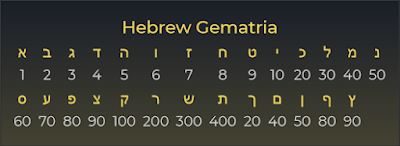

    ... and the other one being esoteric, i.e. secret, undisclosed to the public:


    An interesting correspondence that I found while searching for R. Abellio's work has to do with the values of two Hebrew expressions: השמים (ha-shamaïm, "The Skies") and הארץ (ha-aretz, "The Earth"):
 

    These two values correspond respectively to 38×7 and to 29×7, and using the same cipher, the value of "Eve" חוה is 29:


    ... and the value of Elohim (used as a title of God, even though it is a plural) is 83, the reversal of 38:

 
    Unfortunately I never duly explored this cipher except on this occasion, so I won't be able to show any more curious discoveries with this system — for now. I would recommend, however, if my Readers are able to do it, to try getting a copy either of Maurice Bouisson's book "Magic: Its History and Principal Rites", or alternatively, which can be more difficult, of Raymond Abellio's "La Bible: Document Chiffré". I'm not sure if there is an English translation of this last work, though.

    Eventually this "Hebrew 360" cipher gave me an idea. Well, the number 360 has exactly 24 divisors, but the numbers 1 and 2 aren't included in the "Hebrew 360" cipher because they don't divide the 360° circle into polygons. However, what would happen if I used the complete series of the 24 divisors of 360 with the Classical Greek alphabet — which happens to have exactly 24 letters?

    And so, the experimental "Greek 360" cipher was born:
 
 
     Remembering that the Elizabethan English alphabet also had 24 letters, the same principle could be applied to it (I'll label this the "Bacon 360" cipher, even though it could more correctly be called "Elizabethan 360"):

Note that I=J and U=V, in the Elizabethan English alphabet.

    In this case, however, we should remember two things: (1) that this is an experimental cipher, which means that I don't have any proofs that this cipher was used before; and (2) that it would only make sense to use this cipher in the right context, which could either be related to the historical period involved in our research, or to the subject that we're studying. It would make sense, for example, to explore this cipher in the context of the Elizabethan Era, or in the contexts of Rosicrucianism or Freemasonry, for example, since the Elizabethan ciphers have been consistently used in these contexts for centuries.

* * *

    My work with this kind of ciphers didn't end up here, though. Regarding the Hebrew and Greek alphabets, I also thought that there could be yet another cipher for the alternative forms of these alphabets: one for the Hebrew alphabet including the 'soffit' (final) forms of the letters Kaph, Mem, Nun, Phe & Tzaddi, and one for the Greek alphabet which includes the obsolete letters Vau/Digamma, Qoppa and Sampi. Notice that these alternative forms of these alphabets contain exactly 27 different values...


    So a question was raised in my mind: what is the smallest number that has exactly 27 divisors, including itself? And the answer to this question is the number 900, which by a coincidence happens to be the maximum value in both of these ciphers. So with this data in our hands, we can safely build two alternative ciphers for the Hebrew and Greek alphabets, where instead of having the units, the tens and then the hundreds, we'll have instead all 27 divisors of 900, from 1 to 900:


    With a bit more imagination (which is already too fertile, I would say 😅) we could also apply this list of the 27 divisors of 900 to Agrippa's Latin cipher, which also uses the numbers from 1 to 900 (even though in the usual groups of units 1-9, tens 10-90, and hundreds 100-900):

 
    In the future I may dedicate some time to finding qabbalistic patterns with these ciphers. For now, as I only devised them but never actually explored their potential, they will have to remain as references for my Readers. However, if anyone among my Readers finds some value in these experimental ciphers and decides to share their work with me... well, I will appreciate very much if you show me some of your own discoveries with them!

    However, a final word is needed (again) about these ciphers based on the divisors of numbers. My Readers should be aware that these are all modern & experimental ciphers, which means that (as far as I know) they don't have any historical origins in the past — at least, excepting the cipher I called "Hebrew 360", which was first mentioned by Raymond Abellio. So in our work with them we should always take this into consideration.
 
    To conclude...
 
 
Some Final Notes
 
 
     I really hope that this presentation of the Mathematical Ciphers will give you, my dear Reader, a more solid knowledge on the origins of some of these ciphers. While some of them can be tracked to at least the 17ᵗʰ century, like the Polygonal ciphers, or the Extended Alternative cipher, others seem to be modern inventions and so should be properly called experimental ciphers. In fact, there are no limits to experimental ciphers, and anyone can create their own experimental cipher, be it Mathematical or not. In fact, I had many ideas that I didn't include in this presentation, or even in some of my previous texts, but I will expose some of them in some future papers.

    For now, I will make a short pause in this series of articles about the History of Ciphers. Instead, I think that the time has come to write shorter, more specific articles — not only about the ciphers themselves, but also about the Practice of Gematria, as well as some examples of discoveries and curiosities that I've found in my work with Gematria and its many different kinds of ciphers.

    If any of my Readers would wish to exchange a word or two with me, I humbly ask you to either use the "Comments" form at the end of this text, or the "Contact" form in the PC version of this blog (right menu).
 
    I bid all my Readers farewell... for now.
    Hopefully the next post will be a pleasant surprise. 😁 
 
 
    Luís Gonçalves

Tuesday, October 19, 2021

"History of Ciphers" (part 4d) - The Thelemic Ciphers (IV)

    Dear Reader,


    In this fourth exposition of the Thelemic ciphers, my approach will be entirely different from my previous texts. The reason for this lies in the fact that I never duly explored these ciphers, and also, as it is a really big number of ciphers that I will talk about (comparatively to the other topics), I've chosen to just give a simple description of each cipher and my own comments, without being too elaborate. A set of (mostly online) references will also be given for each cipher, so that my Readers can get more information directly from the respective sources, and not be limited by my own brief explanations.
 
    There will only be one cipher that I explain more in-depth, as that cipher was devised by me in order to answer some of the riddles in Liber AL vel Legis — so, as you can imagine, I did explore it a lot. This will be the second time that I explain this cipher online. The first time was in a fundamentalist forum about Thelema, and it didn't... go as planned. 😅
 
    With these words, let us get to the fourth and final (finally!!!) part of this history of the Thelemic ciphers.
 
 
History of Ciphers
by Luís Gonçalves
 
Part 4: The Thelemic Ciphers (IV)


    In my first presentation of the Thelemic ciphers, I explained that since Aleister Crowley passed away in 1947, many people have tried to find their own "solutions" to the riddles of the Book of the Law; and since computers appeared, many, many ciphers were specifically devised (or in other cases, adapted/adopted) in order to accomplish this end. As there is an ever-growing number of these ciphers, this subject has become a taboo in most Thelemic circles. In some more fundamentalist cases, if you refer to any specific system of English Gematria as being a possible key to the mysteries of Liber AL, you will be ignored at best, or ridiculed at worst.
 
    Please be aware, dear Reader, that the order in which I'm showing these cipher has nothing to do with their "level of importance". It was just the order that I've chosen, for no other reason except my personal preference.
 
    The last of the ciphers presented in this text will be special, however. It is in fact my experimental cipher, that I devised while being inspired by the curious structure of James Lees' English Qaballa. As it is "my" cipher and the last one to be explained in this text, I will also talk a bit — not much — longer about it, since I explored it a lot more than all other ciphers in this text you're reading.

* * *


    The first cipher I will mention is one that I've already (very) briefly mentioned in my second text about the Thelemic ciphers. I'm talking about...


Linda Falorio's "Liber CXV: The English Qabalah"

From Liber CXV: The English Qabalah, by Linda Falorio.

    Author/discoverer: Linda Falorio (@anandazone).
 
   Year of discovery: 1979, according to Kenneth Grant in "Hecate's Fountain" (1992).
 
    Personal notes:
 
    The method of discovery of this cipher is completely unknown to me. Linda Falorio seems to have taken into consideration a wide array of sources for some of these correspondences between letters and numbers. A source that seems to be extremely important in her work is Robert Graves' book "The White Goddess", which contains many New Agey reflections on the ancient Celtic "Tree alphabet" called Ogham and its connections with the cycles of Nature. Some of these numerical correspondences seem to be a bit arbitrary, and apparently they don't follow any specific order (except a rather vague connection with the Ogham alphabetic sequence).

    In the table above, the values between parentheses correspond to the value of those letters in "sacred spellings".

    Online sources:

    Book of Numbers (Gematria database)

* * *


Samuel K. Vincent's "English Qabalah"


Author/discoverer: Samuel K. Vincent (pseudonym of Emery Moreira).
 
    Year of discovery: 2008.

    Personal notes:

    This system seems to have been based on the famous verses from Liber AL vel Legis:

"Aye! listen to the numbers & the words: 4 6 3 8 A B K 2 4 A L G M O R 3 Y X 24 89 R P S T O V A L. What meaneth this, o prophet? Thou knowest not; nor shalt thou know ever. There cometh one to follow thee: he shall expound it. But remember, o chosen one, to be me; to follow the love of Nu in the star-lit heaven; to look forth upon men, to tell them this glad word." (AL II:75-76)

    The letter values seem to have been derived from this sequence, after applying it to the English alphabet, and using Hebrew Gematria as a basis for the values of the letters in the sequence of Liber AL. For example, the seventh character in the sequence from Liber AL is "K" = Hebrew letter Kaph = 20, so "G" (the seventh English letter) is given the value 20. And so on, and so on.
 
    The alternative values are given to the values depending on them being "soft" or "hard" (as is the case of letter "C"), "balanced" or "averse" (the letter "L"), final or middle/initial (the letter "N"), and a lot of other special 'conditions' of the letters. The reason why some of these values were chosen isn't always clear, and an abundance of alternative values for the letters does not lend this system enough consistency, in my opinion.
 
    Online sources:

    The Lexicon (Gematria database)

* * *

 
"The English Cabala - 111" by Perseverando
(a.k.a. "1=A=0" / LVX & NOX ciphers)

"The Order & Value of the English Alphabet" by Shane Clayton, 1995.

    Author/discoverer: Shane Clayton (Frater Perseverando).

    Year of discovery: 1995.

    Personal notes:

    After James Lees' English Qaballa (a.k.a. "ALW cipher"), this was perhaps the next system of Thelemic Gematria that I learned about. I really enjoyed it because of its simplicity. My Readers should know that this "cipher" is in fact two ciphers: one corresponding to the "order of the English Alphabet" (A=1), and the other corresponding to the "value of the English Alphabet" (A=0). Later, Clayton called these the "LVX" (Light) and "NOX" (Night) ciphers respectively. It's curious to note the similarity between "1=A=0" and the Gnostic name IAO — a detail which was of great importance to the author by the time of discovery of these ciphers.

    Notice, however, that if you look closely into this table, the letters "Y" and "X" are switched. This is not an error and it seems to be derived from the author's interpretation of a part of the above mentioned riddle from Liber AL II:76 ["... Y X 24 89..." — number 89 is the 24th prime].
 
    Using the NOX cipher, "The English Cabala" = 111.

    Online sources:

    The English Cabala - 111 (archived — this is a must-read)
    The Numbers and the Words (archived — fairly big Gematria database)
    Liber A vel Follis - The Book of the Holy Fool (An inspired text received/channeled by Frater Perseverando on January 23, 1995.)

* * *


The "English Qabalah" of AREXZ 1496
(a.k.a. English Extended)

Custom cipher table made with GEMATRO - Gematria Calculator. Click to enlarge.

    Author/discoverer: AREXZ 1496, also known as Tau Aleph, Bishop and founding member of the Ecclesia Gnostica Universalis (EGnU).

    Year of discovery: most probably 2001.

    Personal notes:
 
    This is a very simple and straightforward system of Gematria, with much in common with Hebrew Gematria. It attributes values to the letters by following their natural order: the first nine letters correspond to the units, from 1 to 9; the following nine letters correspond to the tens, from 10 to 90; and the final eight letters correspond to the hundreds, from 100 to 800.
 
    Obviously, this is the same system as the one we now know as "English Extended". Only the name is different.
 
    Using this cipher, "AREXZ" = 1496.
 
    Online sources:
  
    The English Qabalah of AREXZ 1496 (Gematria database)
 
* * *
 
 
"Mars Kamea English Gematria" by Frater RIKB

Cipher table by Frater RIKB (link).

    Author/discoverer: Frater RIKB. I don't know his real name.

    Date of discovery: April 2003, according to R. Leo Gillis in "Secrets of the Cipher Naughts".

    Personal notes:

    This cipher was devised from the Magic Square (in Hebrew: קמיע Kamea, meaning "talisman") of Mars, this being a table of 5×5 squares containing the numbers from 1 to 25, so that their sums by line, column and diagonal are always the same. Applying a clue contained in Liber AL:
 
"Paste the sheets from right to left and from top to bottom: then behold!" (AL III:73)
 
    ... and noting that there are 26 letters in the English Alphabet, Frater RIKB took A as Zero, and then found the remaining correspondences by pasting the "sheets" (i.e. the letters) "from right to left and from top to bottom", thus devising the Mars Kamea English Gematria.

    Using this cipher, "Mars square" = 107 = "Letter" = "Fivefold".

    Online sources:

    Mars Kamea English Gematria (contains a small Gematria database)
    Liber 244, The Book of Eternal Burning (PDF, 424 KB. Contains an analysis of AL II:76 with the Mars Kamea English Gematria)

* * *


The "Toavotea Key" by John Farthing II


    Author/discoverer: John Farthing II (Frater Omnia Redementur).

    Date of discovery: January 26, 2003.

    Personal notes:

    "Toavotea" stands for "The Order And Value Of The English Alphabet", no doubt inspired by a passage from the Book of the Law:
 
"Thou shalt obtain the order & value of the English Alphabet; thou shalt find new symbols to attribute them unto." (AL II:55)

    The process of creation/discovery of this cipher seems to have been partly logical and partly intuitive, but it was mostly based on a study of the "grid" in the manuscript of the Book of the Law (image here). At this time of writing I am unable to understand all the reasonings behind this cipher and how these values were obtained.
 
    Using this cipher, "Thelema" = 93.

    Online sources:

    Exegesis 1: Toavotea Key (includes a calculator at the end of the page)
(All three links above provide a very large Gematria database)
(Published in the Silver Star journal, issue 1, Spring Equinox 2004)

* * *


The English Qabalah by Frater Zephyros
(Liber 805 vel EQ)

Custom cipher table made with GEMATRO - Gematria Calculator. Click to enlarge.

    Author/discoverer: Paul Rovelli (Frater Zephyros).

    Year of discovery: (2010 maybe? Not sure about this)

    Personal notes:

    This cipher had as a direct inspiration the verse in Liber AL II:55 ("Thou shalt obtain the order & value of the English Alphabet"). The author interpreted this as meaning the order in which the letters appear in the text of the Book of the Law, thus finding this specific order for the letters (H A D T E M N I F S O U...). Then, similarly to Hebrew Gematria, the letters were given certain values: first the units from 1 to 9, then the tens from 10 to 90, and finally the hundreds from 100 to 800.
 
    The fact that the first chapter of Liber AL is the only one which contains all the letters of the alphabet (the 2nd and 3rd chapters lack the "Z") may give some significance to this specific order. This is a very ingenious cipher, even though I haven't explored it deeply enough.

    Using this cipher, "EQ" = 805.

    Online sources:

    Liber 805 vel EQ (PDF, 584 KB)
    EQ Sepher Sephiroth (revised) (DOC, 502 KB)
(Large Gematria database; includes Liber AL enumerated)
(Includes the two texts above and some more)

* * *
 
 
Ron L. Adams' three Thelemic Numerologies
(HADT, NUTH & ABRH)


Custom cipher tables made with GEMATRO - Gematria Calculator. Click to enlarge.

    Author/discoverer: Ron Lee Adams (Frater Sabaechit).

    Year of discovery: unknown / undisclosed (?).

    Personal notes:
 
    I only know of one online resource for these ciphers, and it is the webpage of Ron Adams (see below). Even though these ciphers are nowhere explained, the reasoning behind them is sound. These ciphers, like the one mentioned above (EQ 805) are all derived from the order of appearance of the letters of the alphabet in the text of the Book of the Law:

    — The HADT cipher corresponds to the first chapter, which begins with the words: "Had! The manifestation of Nuit". Ron associated it with Manifestation Magick.

    — The NUTH cipher corresponds to the second chapter, beginning with the words: "Nu! the hiding of Hadit". Ron associated it with Revealing Hidden Mysteries;

    — The ABRH cipher corresponds to the third chapter, which starts with the words: "Abrahadabra; the reward of Ra Hoor Khut". Ron called it The Reward of Horus the Avenger.

    Note that of the three chapters, the first is the only one containing all the letters of the alphabet. The second and third chapters don't contain the letter "Z", so it was simply added to the end of the sequence in the NUTH and ABRH ciphers.

    Using these ciphers:

    "Nuit" = 31 in the HADT cipher;
    "Hadit" = 31 in the NUTH cipher;
    "Ra Hoor Khut" = 62 (or 31+31) in the ABRH cipher.
    
    (Note that "Thelema" = 93 in Greek Isopsephy = 31+31+31)

    Online source:

    The Fourfold Secret of Liber AL (contains a Gematria database)

* * *


Qabalistic Permutations of the English Alphabet
(EQ-1 through EQ-25)


    Author/discoverer: N/A.

    Year of discovery: N/A.

    Personal notes:
 
   James Lees' English Qaballa is by far the most well-known of all Thelemic ciphers. It's structure is very curious and symbolically relevant because it is actually a permutation of the English Alphabet: from A=1 we count 11 letters until we arrive at L=2, continuing this cycle with W=3, etc, until P=26.

    In fact, this cipher was one among many possible permutations of the alphabet that had already been explored in a Gematria program called Lexicon by the late Soror Ishtaria (archived references to it can be found here and here). Unfortunately, this software won't run in most modern computers. I was one of the lucky guys who used it for some time, and I had the opportunity of seeing all the (hundreds? thousands?) of permutations of the alphabet that this software allowed to use, even though the mostly explored cipher was, obviously, James Lees' English Qaballa / ALW cipher.
   
    In my studies about Thelemic ciphers, I was recently inspired by this cipher in order to devise other ciphers that could also be derived from permutations of the English Alphabet. This can be done linearly and without interruptions only with those permutations whose cycle is neither a divisor of 26 (the number of letters of the alphabet) nor a multiple of its divisors. In so doing, I found exactly 11 ciphers (besides the Alphabet itself, here shown as "EQ-1") that matched that condition:

    EQ-01: A B C D E F G H I J K L M N O P Q R S T U V W X Y Z
    (English Ordinal / Simple English Gematria / Serial English)

    EQ-03: A D G J M P S V Y B E H K N Q T W Z C F I L O R U X

    EQ-05: A F K P U Z E J O T Y D I N S X C H M R W B G L Q V

    EQ-07: A H O V C J Q X E L S Z G N U B I P W D K R Y F M T

    EQ-09: A J S B K T C L U D M V E N W F O X G P Y H Q Z I R

    EQ-11: A L W H S D O Z K V G R C N Y J U F Q B M X I T E P
    (This is the cipher known as English Qaballa / ALW / NAEQ)

    EQ-15: A P E T I X M B Q F U J Y N C R G V K Z O D S H W L

    EQ-17: A R I Z Q H Y P G X O F W N E V M D U L C T K B S J

    EQ-19: A T M F Y R K D W P I B U N G Z S L E X Q J C V O H

    EQ-21: A V Q L G B W R M H C X S N I D Y T O J E Z U P K F

    EQ-23: A X U R O L I F C Z W T Q N K H E B Y V S P M J G D

    EQ-25: A Z Y X W V U T S R Q P O N M L K J I H G F E D C B

    Note that in each of these ciphers, the first letter is always A=1, and then it continues with the second letter being given the value of 2, etc, until 26. For example, in the case of EQ-5, we begin with A=1, then we count 5 letters to F=2, then K=3, etc, until we reach V=26.

    The only finding that was worthy of note when I used these ciphers (yeah, I actually used all these ciphers, all at the same time — call me crazy!), was two words which have the exact same value in all these ciphers: "Isis" which sums 56, and "Aum. Ha!" (the final words in the Book of the Law) which sums 44.

(click to enlarge)

    The equivalence between the name of the Egyptian goddess Isis and the number 56 was of special interest in a Thelemic context, since in a section of the Book of the Law, "Isis" seems to be alluded to as the word of Nuit, whose number is 56:
 
    "Now, therefore, I am known to ye by my name Nuit, and to him by a secret name which I will give him when at last he knoweth me. Since I am Infinite Space, and the Infinite Stars thereof, do ye also thus. Bind nothing! Let there be no difference made among you between any one thing & any other thing; for thereby there cometh hurt." (AL I:22)

    "But whoso availeth in this, let him be the chief of all!" (AL I:23)

    "I am Nuit, and my word is six and fifty." (AL I:24)

    "Divide, add, multiply, and understand." (AL I:25)


    Working with these ciphers also showed me a very intriguing connection between EQ-21 (AVQ) and Joel Love's Cipher X, as both appear to share some similarities in their alphabetical sequences. Just compare Cipher X...

    K F W R M D Y T A V Q H C X O J E L G B S N I Z U P

    ... with EQ-21:
 
    A V Q L G B W R M H C X S N I D Y T O J E Z U P K F
 
    ... and you'll notice how there are groups of 3 letters following exactly the same order in both ciphers (ex.: "AVQ", "OJE", "ZUP", "DYT", etc).
 
    Some time after I worked with these ciphers, I found that the website of Ron Lee Adams (already referred to in the previous section) also included calculators for these "EQ" ciphers — and more! 👀

    In fact, it includes calculators for all permutations of the English Alphabet, from EQ-1 to EQ-25 (i.e. also including EQ-2, EQ-4, etc, which I didn't include in my list). Links to those calculators will be given right below.

    Online sources:

    Quest for the English Qabala (EQ-1 through EQ-9)
    Quest for the English Qabala 2 (EQ-10 through EQ-18)
    Quest for the English Qabala 3 (EQ-19 through EQ-25)

* * *


My own experimental Thelemic cipher:
Abrahadabra Cipher / Elevenfold Qabalah (AC/EQ)
 
Custom cipher table made with GEMATRO - Gematria Calculator.

    Author/discoverer: Luís Gonçalves.

    Year of discovery: around 2008.

    Personal notes:
 
    Obviously, I'm the best person to talk about this cipher, as it was me who devised it. And in fact, that's why I left it for last. 😁 
 
     The name "Abrahadabra Cipher" was inspired by two things: firstly, the Law of Thelema ("Do what thou wilt shall be the whole of the law") has 11 words, just like Abrahadabra, the Word of the Aeon, has exactly 11 letters, so it served as a nice name for my cipher. And secondly, "Abrahadabra Cipher", written as "A.C.", can also serve for "Aleister Crowley", thus serving as a kind of 'homage' to the man who was behind the doctrine/religion/philosophy of Thelema.

    The secondary name that I devised for this cipher was initially "Elevenfold Gematria", but more recently I re-baptized it as Elevenfold Qabalah, for some very specific reasons:

    — The acronym "EQ" is used as a synonym for a lot of Thelemic ciphers (this same article is the proof of that);
    
    "EQ" sums 11 in AC/EQ:
 
 
    "Elevenfold Qabalah" sums 65 in AC/EQ, and 6+5=11:


    Being based on a cycle of 11 numbers/letters, this puts this cipher in strict connection with James Lees' English Qaballa. In fact, if we write the letters corresponding to the numbers 1-8-4-11-7-3-10-6-2-9-5 in the AC/EQ cipher, we'll obtain the same order of letters as in English Qaballa:

    A L W H S D O Z K V G R C N Y J U F Q B M X I T E P

    The Abrahadabra Cipher / Elevenfold Qabalah also delivers some interesting results when it is applied to the Book of the Law, particularly to the first verses in each chapter:

"Had! The manifestation of Nuit" (AL I:1)

"Nu! the hiding of Hadit" (AL II:1)

"Abrahadabra; the reward of Ra-Hoor-Khut" (AL III:1)

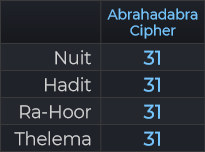
    Particularly, the names of the speakers in those chapters are numerologically relevant, since "Nuit", "Hadit" and "Ra-Hoor(-Khut)" all add to 31, and this matches the value of "Thelema" as well (and as we know, in Greek, "Thelema" = 93 = 31+31+31):


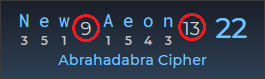
    Likewise, the first words in the first and second chapters, both add up to 13 (a reflection of 31):
 

     If we calculate the value of "Ra-Hoor-Khut", the 'speaker' in the 3rd chapter of the Book of the Law (usually considered to be the 'Lord of the Aeon'), we'll obtain a curious set of matches as well:


    In my presentation of James Lees' English Qaballa, I also talked about a verse in which the number 56 is explicitly connected to Nuit:

"I am Nuit and my word is six and fifty" (AL I:24)

    ... and I also mentioned another verse where Nuit is called the "azure-lidded woman" and how that seemed to imply a reference to the specific order of the letters in English Qaballa (ALW) — and by extension, in AC/EQ:

"O azure-lidded woman, bend upon them!" (AL I:19)

    In fact, "azure-lidded woman" sums 65, the reversal of 56. We've seen how reversals seem to be recurrent with this cipher:


    Finally, the last words in the Book of the Law are "Aum Ha", and interestingly enough, they perfectly match the value of "New Aeon" — again, involving a reversal:


    A negative characteristic in this cipher, however, is that it only contains low values (from 1 to 11 max.) so, like the reduction ciphers that I've explored in some of my previous posts, it allows for less effort in order to find a match. Of course, the easier it is to find a match, the less strength that match will have (mathematically / probabilistically speaking) — and my own experimental AC/EQ cipher also fails in that test.
 
    Anyway, as my intention in writing about these ciphers is mostly to keep my Readers informed, and to let them know about other alternative ciphers, I took the liberty to talk about a lot of ciphers in this text — even some that I really don't like. As it is usually the case, I tend to avoid making judgments against any cipher, since I prefer my Readers to take their own conclusions, independently from what I might think or say.

    Online source:

    — The only online reference to this cipher is a single text that I posted on the "Lashtal" forums, on December 15th, 2008. It was the first and last time that I wrote about this cipher, at least on the internet. I must admit that my post was a bit clumsy and I wasn't taken very seriously — which anyway was more or less to be expected, since most systems of English Gematria aren't generally taken too seriously in a Thelemic context (except in some limited circles), when compared with their Hebrew and Greek counterparts. Anyway, here's this cipher again, 13 years passed, for everyone who wants to explore it further. 

* * *


Concluding Remarks on the Thelemic ciphers


    In this series of articles about the Thelemic ciphers I talked about several different ciphers that are mostly (but not only, in some cases) used in the context of Thelema:

    — In Part 1, I explored the basic history and events leading to Aleister Crowley's channeling of Liber AL vel Legis (The Book of the Law), the religion / doctrine / philosophy of Thelema, and how Liber AL contained many clues and riddles that seemed to imply that a system of English Gematria would be found in order to unravel its mysteries. One of the first progenies of this "quest" for an English Gematria was James Lees' English Qaballa, also known as the "ALW" Cipher (for all those using Gematrinator, it's the "ALW Kabbalah" cipher). It has nothing to do with Kabbalah, however, and the circumstances of its discovery and the events leading to it are all highly worthy of attention, and this cipher is truly a very strong candidate for a promised system of Thelemic Gematria. It delivers some strong results, even though I would contend that it is fairly easy to get "significant" matches with each and every Ordinal-like cipher (meaning: having only small values, usually between 1 and 26).

    — In Part 2, I explored two ciphers mostly, even though I referred to 4 ciphers in that text. The two ciphers that I explored the most — without, however, doing them the justice that they deserve — were R. Leo Gillis' Trigrammaton Qabalah (the "LCH Kabbalah" cipher in Gematrinator) and Edgar Joel Love's Cipher X (called "KFW Kabbalah" in Gematrinator). Trigrammaton Qabalah has the merit of being directly inspired on Crowley's rough sketch(es) of a possible "English Qabalah", based on his own Liber Trigrammaton, while Cipher X is tightly connected to James Lees' English Qaballa, being a base-3 inversion of that cipher. Both of these ciphers are highly interesting, and the works of their authors didn't receive the treatment and further exploration that, in my opinion, they justly deserve.

    The other two ciphers that I mentioned in Part 2 were David Cherubim's Thelemic English Qabalah, which is also called "English Sumerian" in Gematrinator, as well as Aleisterion's AngloQabalistic Key, which coincides with the more widely known English Ordinal, or Simple English Gematria. These two were only briefly explored — in fact, they should have been included in this fourth part, but anyway, there they are. 😅

    — In Part 3, it was the time of two non-Thelemic ciphers to be explored in a Thelemic context. The first one was my all-time favorite cipher, and the one that was introduced to the world of Gematria through my work alone — the Illuminati Novice cipher. In fact, for many years I seemed to be the only nutcase researcher in the whole world who tried to bring people's attention to this cipher, and how it showed some curious patterns and "coincidences" when it was applied to the Great Seal of the United States (see my first text in this blog dedicated to it). So this time it was the time to apply this cipher to the context of Thelema, due to some synchronicities of symbolism and meaning that were to be found between Thelema and the Bavarian Order of the Illuminati.

    The second cipher that I talked about in the third part was a cipher that came to my life in April this year, through a series of intriguing synchronicities and that became one of my most favorite ciphers of all times, due to its internal consistency and "non-redundancy": the Anglossic Qaballa (AQ), also known as Alphanumeric Gematria. This cipher isn't available in Gematrinator, even though it should, in my opinion. Just like the Illuminati Novice cipher, this is not, technically speaking, a Thelemic cipher — even though it is true that it delivers some eye-opening results when applied to the Holy Books of Thelema. This is mostly an experimental field to explore further, and it was started by the creator of this cipher: the "borderline philosopher" Nick Land, who wrote "Qabbala 101" (link here).

One of the first references to the AQ cipher that I know of, from the CCRU / 0[rphan] d[rift] collaborative work "Meshed Syzygy" (1999). Click to enlarge.

    — In this 4th Part, I decided that there were many other Thelemic ciphers that also deserved to be mentioned, even though not as thoroughly explored as the previous ones. After all, wasn't I writing about Thelemic ciphers? What sense could there be in selecting only a few Thelemic ciphers, while ignoring the rest? So that's why I wrote this 4th part. I didn't explore any of these ciphers (excepting my own: AC/EQ) so I took the decision of giving only the essential information about each cipher, and giving some online sources for them, so as not to make my text unnecessarily long and boring. In so doing, I'm giving my Readers the opportunity to know other alternative/experimental systems of English Gematria, so that they (i.e. You) can explore them further, and maybe even experiment with other ciphers or techniques and see what results can be obtained with them. This can be highly enriching in our practice of Gematria. Experimentation is always welcome, but it should always be tempered with good sense.

* * *


    Dear Reader,


    I hope that this fourth part of my "History of Ciphers" has been enlightening to you: or at least useful in some sense.

    In the next part I will be exploring the Mathematical Ciphers. This is a field where there is an incredible lack of information, allied to the fact that most of these ciphers are experimental. However, during these last weeks, while I was writing this same text, I came to find some historical sources for most of these ciphers (the oldest one that I know of is from 1683) — and as Gematrinator also includes some of these mathematical ciphers, I thought that a text like this would be necessary, so that our knowledge of these ciphers becomes more complete.

    In the meantime, if any of my Readers wishes to send me a word or two, or even send me suggestions of ciphers to write about, I will be most thankful for receiving and answering your messages. You can do this by using the Contact Form at the right side of this Blog (PC version only), or by using the Comments section at the end of each blog post.

    Please receive my kindest regards,

    
    Luís Gonçalves

Latest Post:

Gematria, Hyperstition and Alphanumeric Qabbala — An Interview

    Dear Reader,     The following material appeared in an interview I gave to my dear friend Phoebus Glykon , where we talked about  Alphan...

Popular Posts: