Showing posts with label gematria. Show all posts

Saturday, May 25, 2024

Alphanumeric Qabbala & the Riddles of AL

    Dear Reader,
 
 
    In this new text I will present my solution to some of the riddles in Liber AL vel Legis (The Book of the Law), the central sacred text in the religion / philosophy / creed of Thelema.
 
    I should make it clear, however, that for decades I thought it would be useless to try to find a solution to the riddles of AL, particularly the one in AL II:76 ("the numbers & the words") and the one in AL III:47 (the "grid" page). I studied many proposed solutions, particularly the one involving the cipher known as English Qaballa / ALW cipher / NAEQ, which immediately became my favorite because it seemed to make perfect sense — well, at least when compared to all the available "solutions".
 
    However, it seems that the Universe always has a sense of irony, and one day in early 2023 an entirely new "solution" made itself known to me, while I was writing my longest and most deeply encoded text about Gematria that I have written to this day: The wonders & magic of Alphanumeric Qabbala. In this text I explained how this solution works, even though it was far from complete or perfect, so this time I will greatly expand on my previous exposition of this solution. Also, in my previous text I focused my attention on the riddle of AL II:76 only, while at this time of writing my research has advanced a lot — and this solution seems to be capable of, in a very simple and elegant way, answering the riddle in the so-called "Grid page" as well.

    In fact, what distinguishes this new solution that I propose from all the other solutions — including English Qaballa — is the fact that it is so simple and, as far as I can tell, carries immediate conviction. Likewise, this solution is the only one to use exactly the same Key (actually a "new symbol" — you know what I mean if you studied the Book of the Law) to answer both riddles in AL II:76 and AL III:47, in a very simple and elegant way.
 
    Anyway, my intention in writing this text is more to provide a new line of investigation for my Readers who have some interest in this specific subject, rather than to present a "final word" on this subject. In so doing, I will also explain my line of thought, so that the Readers may understand why I think that this solution actually works — even though, of course, the final word on the validity (or not) of this "solution" cannot be mine, but instead it could eventually be demonstrated beyond any doubt one day in the future. My intention, thus, is only to show the way, or at least to open a door, so that others can explore further this uncharted territory.
 
    One thing I would like to suggest first to my Readers, would be to read R. Leo Gillis' excellent essay called "Secrets of the Cipher Naughts – A Survey of Solutions to Liber AL verse II:76", which is freely available to read on the author's website (PDF - 1.7 MB).

    In this essay, Gillis explains many solutions that were given to this specific riddle over the years, giving all details about each solution and detailing its pros and cons. I must say that I really like this work, because it contains a wealth of information about this subject that you simply cannot find anywhere else. Also, it ultimately served to measure the "strength" of this solution against other solutions, and I must say that, considering all pros and cons, this solution seems to me (the most suspicious person who could give an opinion about this) to be far superior to all the other solutions.
 
    In any case, if my Readers aren't quite sure of what I'm talking about, before we delve more deeply into the famous Riddle of Liber AL, I would invite my Readers to revisit my first text on the Thelemic ciphers, so that they can get a bit more of context on the mysteries and riddles of Liber AL / The Book of the Law.
 
* * *
 
 The Alphanumeric Solution to Liber AL
 
 
     This solution occurred to me on January 31ˢᵗ, 2023, while I was finishing writing "The wonders & magic of Alphanumeric Qabbala", an article about a continuous, non-redundant, alphanumeric cipher that treats the entire sequence of digits from 0 to Z as if they were numerals in a modulus 36 notation.

 
    So, you may ask: is the solution... a cipher?
    
    Well... the short answer is: yes, it's a cipher. But the long answer is that it isn't just a cipher, and hopefully you will understand how this is a whole transformation of the English Alphabet into a magical tool, using "new symbols", and is especially fitting for a creed or philosophy founded by someone who called himself The Beast 666.
 
* * *
 
How does this Alphanumeric solution work?
  
 
    The Alphanumeric solution I'm suggesting allows us to take the following conclusions:
 
  • The Riddle of AL II:76 cannot be decoded into a message because it is not a message. In fact, it was never intended to be decoded that way, indicating, instead, how the cipher (which is ultimately the true solution to the Riddle) can be derived. It does this in three different ways: (1) through the disposition of the numbers & letters and "their position to one another" (according to AL III:47); (2) by hiding a secret pattern in the specific numbers and letters chosen for the Riddle, which can only be decoded through the cipher and some of its 'special' properties; and (3) the verse immediately before the Riddle seems to contain a clue about the structure of the cipher itself. In so doing, this solution explains not only why the Riddle contains numbers and letters, but also why those specific numbers & letters were used.

  • The key that solves the riddle in AL II:76 is the same key that solves the riddle in the so-called "Grid page" in the manuscript of Liber AL vel Legis, in a very simple and elegant way. This alone is extremely curious and noteworthy, and since other 'solutions' don't show a comparable efficiency in solving both riddles using exactly the same key and in a simple way like this one, then I can only believe that this is the only solution that actually works — and it makes sense too, and my Readers will understand why this is so when they finish reading this text. Hopefully, my text will stir some minds, and convince new and already existing researchers into exploring this solution more deeply.

  • There seem to exist some clues in the source material, as well as in other Thelemic Libri (most notably perhaps Liber 777) indicating that the solution to the Riddle is Alphanumeric — i.e. that "the numbers & the words" in the Cipher correspond to a magical Alphabet of the Beast.

  • The cipher in question seems to be extremely relevant in a Thelemic context, even though it has been consistently ignored by almost everyone practicing some kind of English Gematria in the context of Thelema. It also allows us to find "new symbols" to which we can attribute the "order & value of the English Alphabet" (according to AL II:55).

  • This solution/cipher delivers some outstanding results when applied to some key terms in Thelema, including most notably the name of the Book of the Law, as well as the Law of Thelema: "Do what thou wilt shall be the whole of the law".

    Let's take a deeper look at how all of this works:
 
* * *

The Riddle of AL II:75-76
  
 
    II:75. "Aye! listen to the numbers & the words:"
 
    II:76. "4 6 3 8 A B K 2 4 A L G M O R 3 Y X 24 89 R P S T O V A L. What meaneth this, o prophet? Thou knowest not; nor shalt thou know ever. There cometh one to follow thee: he shall expound it. But remember, o chosen one, to be me; to follow the love of Nu in the star-lit heaven; to look forth upon men, to tell them this glad word."
 
     About this Riddle, Crowley writes the following in his Commentaries on the Book of the Law (link here):
   
    "This passage following appears to be a qabalistic test (on the regular pattern) of any person who may claim to be the Magical Heir of The Beast. Be ye well assured all that the solution, when it is found, will be unquestionable. It will be marked by the most sublime simplicity, and carry immediate conviction."
 
    While I don't claim to be the "Magical Heir of the Beast", whatever that means or implies, I felt the need to share this solution precisely because, when I found it, it was absolutely unquestionable, was marked by the most sublime simplicity, and carried immediate conviction. 
  
     On that day, while I was looking at the cipher chart of Alphanumeric Qabbala, I suddenly remembered that in the Riddle of AL, letters always come after numbers:

4 6 3 8 A B K / 2 4 A L G M O R / 3 Y X / 24 89 R P S T O V A L
 
     The verse immediately before the Riddle invites us to "listen to the numbers & the words", and Alphanumeric Qabbala is composed precisely of "numbers" (i.e. numerals) and "words" (i.e. letters, which we use to write words), so I thought that maybe this could be a clue to the cipher that was intended to be used in order to 'unlock' this Riddle.
 
    Some days elapsed after I made this finding, and eventually I found some things that seemed to corroborate this hypothesis, and I shared some of them (still very crude and incomplete) in my article about AQ. In the next section everything will become clear.

* * *

The Alphanumeric Solution to AL II:76

 
    In the previous section I explained how my first thought towards an Alphanumeric solution to the Riddle of AL was that, in the Riddle, letters always come after numbers. Another observation that can be made about this is that there are exactly 28 "numbers & words" in the Riddle, 28 being the 7th triangular number. In fact, even if we take the numbers of the chapter and the verse and put them together (i.e. II:76 -> 2:76) we obtain 276, which is also a triangular number. So we can actually write the numbers & the words of the Riddle in the shape of a Triangle. This point was also noted by some other people, as explained by R. Leo Gillis in "Secrets of the Cipher Naughts", particularly Frater RVS in his own solution to the Riddle:


    Now this is very interesting because, as there are 36 characters in the alphanumeric sequence from 0 to Z, and 36 is a Triangular number as well, we can also write the same alphanumeric sequence in the shape of a Triangle. In this presentation I will be calling this symbol the Alphanumeric Triangle (even though I would prefer calling it Alphanumeric Pyramid, for... numerical reasons 😁):
 
The Key — the Alphanumeric Triangle.

     And by a very curious synchronicity, there will be in that Triangle exactly 4 rows for the Indo-Arabic numerals 0-9, and 4 rows for the English letters A-Z, as if they were complementary series.


    Since there are 4 rows for the numerals and 4 rows for the letters in the Alphanumeric Triangle, and remembering that there are 4 groups of "numbers & words" in the Riddle of Liber AL, as we have seen before, we could, in principle, compare the layers of the Alphanumeric Triangle with the 4 groups of "numbers & words" in the Riddle of AL, and see if we can reach a conclusion, or see a connection between them:


    My methodology for the analysis of this connection follows a simple reasoning: compare numbers with numbers, and letters with letters. So if we are to compare these two sets of data, we should find a way to go from one to the other. Or in other words, how can I arrive from "4 6 3 8" (in the Riddle) to "0" (in the Alphanumeric Triangle)? How can "A B K" in the Riddle of AL be related to "A B C D E" in the Alphanumeric Triangle? And how can we go from "6 7 8 9" to "24 89"? If we can find a direct connection between these two sets of data, then it should follow that the Riddle doesn't in fact contain any encoded message, but was made that way in order to encode the cipher itself that should be used to unlock the Riddle.
 
    In terms of the numerical part of the Riddle, the following connections could be made:

Click to enlarge.

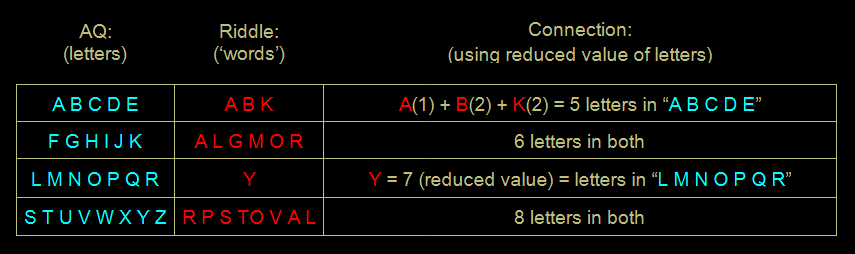
    Regarding the letters, apparently it doesn't look as linear as the example above, since the letter "X" seems to be an anomalous element. However, I found that "A L G M O R" and "F G H I J K" share the same number of letters, as well as "R P S T O V A L" and "S T U V W X Y Z". The other two pairs, instead, can be related through the reduced value of the letters. By "reduced value" I mean the numerological reduction of the value of the letters: so for example, if the letter "L" corresponds to 21 in Alphanumeric Qabbala, its reduced value will then be 2+1 = 3.

Click to enlarge.

    However, there's a detail regarding this decoding of the 'words' in the Riddle that should be mentioned. In some previous solutions that were given before to this Riddle, it is sometimes noted that the "x" in the second line of the manuscript may actually be a multiplication sign and not the letter "X".
 
 
    In the English Qaballa (ALW) solution, for example, it was noted by the late (and sorely missed) Jake Stratton-Kent that that there are 17 "numbers & words" in the first line and 11 in the second (including "x" as a letter), and if we multiply 17 by 11 we'll obtain 187, which is the value of "English Alphabet" in English Qaballa. While this is a noteworthy observation (since in EQ the string of numbers and letters adds to the same value as the full English Alphabet), I couldn't find a different explanation in this specific context of Alphanumeric Qabbala. However, I could point out eventually that, if we consider the "x" to be a multiplication sign and not a letter, then the reduced value of "Y" alone indicates the number of letters in the corresponding layer of the Alphanumeric Triangle, "L M N O P Q R", and so the solution becomes much more straightforward. Only the multiplication (if "x" really is a multiplication sign) remains to be explained.
 
 
Click to enlarge.
 
    To complement this:
    
    The verse immediately before the Riddle invites us to "listen to the numbers & the words", and the Riddle is composed precisely of numbers which are followed by letters. Also, the sentence "listen to the numbers & the words" has exactly 26 letters (excluding the ampersand '&') and has the same value as the complete sequence of the English Alphabet. Considering that this could be a clue to the structure of the cipher that answers the Riddle, we could also note that the first word in this sentence is "Aye!", which starts with an "A" = 10 in Alphanumeric Qabbala. So what this sentence could be telling us is that:

    — The solution is composed of "numbers" (numerals) and "words" (letters);
    — First come the 10 Arabic numerals 0-9 (represented by the initial letter of "Aye!", which corresponds to the number 10 in Alphanumeric Qabbala);
    — After the numerals come the letters A-Z, which will then be represented by the following phrase that has exactly 26 letters, and adds up to the same value as the full English Alphabet.

Click to enlarge.

    Another detail that has been pointed out by R. Leo Gillis when I first told him about this solution is that the word "listen" could be interpreted as "list ten", referring to the 10 numerals (0-9) that come before the 26 letters of the English Alphabet.
 
    As a side note, I would also point another intriguing detail. In the original manuscript of the Book of the Law, there's a first page that is only rarely reproduced in physical copies of Liber AL vel Legis. The page contains some annotations by Aleister Crowley — and there's a calculation at one of the corners of the page that, as far as I know, no one has ever explained before.
 
Click to enlarge.
 
    Is it related to Gematria? I have no idea, and to this day I haven't seen one single explanation of what those values mean, or if they stand for letters. I know, however, that the result of the calculation is quite curious — 1026 — which is not an especially relevant number in terms of Gematria, even though it could be a veiled reference to a cipher containing both "10" (numerals) and "26" (letters). Anyway, I have no way to prove that this was the original intention, so please don't take my word for granted. It's most probably a wild guess... I guess.
 

* * *

The Alphanumeric Solution to AL III:47


Click to enlarge.
 
    Up until now we've seen how Alphanumeric Qabbala could, in principle, be decoded from some clues contained in the text of the Book of the Law, particularly the Riddle in AL II:76. However, none of this would actually be relevant if there weren't other factors somehow confirming this theory, and that's precisely what I'm going to talk about at this moment.
 
    The so-called "Grid page" is a page in the manuscript of Liber AL vel Legis that is different from all other pages in the manuscript, because it contains a grid (which, as far as I know, was added at a later date), as well as a diagonal line, and a squared circle. The original text says the following:

    III:47. "This book shall be translated into all tongues: but always with the original in the writing of the Beast; for in the chance shape of the letters and their position to one another: in these are mysteries that no Beast shall divine. Let him not seek to try: but one cometh after him, whence I say not, who shall discover the Key of it all. Then this line drawn is a key: then this circle squared ⊕ in its failure is a key also. And Abrahadabra. It shall be his child & that strangely. Let him not seek after this; for thereby alone can he fall from it."

    This is another of the most enduring riddles in the Book of the Law. There were some suggestions of solutions to this riddle as well, and one of the most interesting is the one proposed by the adherents of English Qaballa / the "ALW" cipher. However, the solutions proposed to this riddle, at least up until this day, always use different "keys" for this riddle and the riddle in AL II:76 — and this detail alone marks a stark contrast between the Alphanumeric solution and all the other solutions.
 
    In fact, the Alphanumeric solution uses exactly the same key to unravel the mysteries of both AL II:76 ("the numbers & the words") and AL III:47 (the grid page) — and that Key is precisely what I called before the Alphanumeric Triangle:


    In order to understand how this key unravels the riddle in the grid page, let us analyze the original text and divide it into three parts:

    - "Then this line drawn is a key"

    The key is the sequence from 0 to Z, described by the line, from 0 to Z.
 
    - "then this circle squared  in its failure is a key also"

    It's "in its failure" because, in the manuscript, the symbol looks more like a plus sign,  rather than an X, inside a circle. But why "X" exactly? In Alphanumeric Qabbala, the letter "X" equals 33 and both "English" and "Alphabet" sum 137, with 137 being the 33rd prime number. By a curious coincidence, the word "Trigon", not very commonly used as a synonym for "Triangle", also adds up to 137.
 
    And why the circle, then? Well... when you find the "X" that marks the spot, you draw a circle around it in order to highlight it. That's precisely what I did — and then I understood. "In its failure" indeed.

    Other observations are equally possible, namely that: (1) "circle squared" sums 252, while "in its failure" sums 251 — i.e. it misses the mark by 1; and (2) in Elizabethan times, the English Alphabet was known as the "Christ-cross row" — and the letter "X" looks exactly like a Cross.
 
    Anyway, just like "X" can represent the English Alphabet based on the correspondences above, it can also stand for the 10 Arabic numerals 0-9, since 10 is written as "X" in Roman numerals. Thus "X" is truly an alphanumeric key as well, describing simultaneously the sequence of numerals 0-9 and the sequence of letters A-Z.

    - "And Abrahadabra"
 
    Or should we say... Abracadabra? In fact, I believe that "Abrahadabra" is only a key to this riddle in the sense that it is a modification of the magic word Abracadabra, which was always inscribed in the shape of a Triangle. Thus, to say that "Abrahadabra" is a key would be another way of saying that a Triangle is the key. And indeed that seems to be the case.

    Coincidentally, "Abracadabra" adds up to 151, the 36th prime number...
 
A B R A C A D A B R A
A B R A C A D A B R
A B R A C A D A B
A B R A C A D A
A B R A C A D
A B R A C A
A B R A C
A B R A
A B R
A B
A

 
* * *
 
    My most perceptive Readers may remember at this moment that when I presented the alphanumeric solution to "the numbers & the words" in AL II:76, I noted the alternative theory that the letter "X" in the second line of the riddle could in fact be a multiplication sign and not a letter. And you may also remember that, at that time, I also said that it would make all sense to treat that "X" not as a letter, because in that case there would be a perfect match between the 7 letters in the 7th layer of the Alphanumeric Triangle, and the letter "Y" in the riddle of AL, whose reduced value is 7.


    In fact... the "X" that corresponds to the "circle squared in its failure" in the riddle of AL III:47 and, as we have seen before, is a true alphanumeric key, is the same "X" in the riddle of AL II:76 that is treated as different in order to make the riddle work. So we could say that both riddles intertwine around a key element "in its failure" — the letter "X" that represents simultaneously "the numbers & the words" — that is, the 10 numerals and the 26 letters.

My notebook, containing an explanation of the Alphanumeric Solution.


* * *

New Symbols
 
 
 "Thou shalt obtain the order & value of the English Alphabet;
thou shalt find new symbols to attribute them unto". 
 
AL II:55
 
 
    I believe this verse has been the subject of systematic misinterpretation, which has given origin into a whole set of different ciphers that always have something in common: the order of letters of the alphabet is completely different from the one we use everyday (i.e. A to Z). And while all these systems are based on different interpretations of the text of Liber AL vel Legis and all of them certainly have their merits, the fact remains that the text makes it absolutely clear that what is being said here concerns the English Alphabet. And what is the English Alphabet, if not the sequence of 26 English letters from A to Z?

    So if there already is an "order" of the English Alphabet, what is it exactly that is being conveyed by "the order & value of the English Alphabet"?
 
    In my opinion, the interpretation is simple: the "order" that is mentioned in this verse does not refer to a different order of the letters of the English Alphabet, but instead to the order of the English Alphabet coming after the sequence of ten numerals from 0 to 9. So after 9 comes A=10, then B=11, C=12, etc, until Z=35. Thus can the "value" of the letters of the Alphabet be derived from their "order" coming after the numerals from 0 to 9. Also worthy of note is the fact that, in Alphanumeric Qabbala, "order" sums 105 while "value" sums 106, two consecutive numbers — so we could say that the "order & value" of the English Alphabet is based on a continuous sequence, which it is.

    What about the "new symbols"?

    From what has been exposed before, there is at least one obvious new symbol, and that is the Alphanumeric Triangle that I've talked about before.
 
 
    This symbol answers simultaneously the riddles in "the numbers & the words" and the grid page in AL III:47 and it is, in fact, the most simple and straightforward solution to both.
 
    But there's at least another symbol that I already mentioned in The wonders & magic of Alphanumeric Qabbala that should be mentioned here again: and that is the Alphanumeric Square: a magic square that contains all 36 alphanumeric digits from 0 to Z.


    In fact, among the many curiosities about this magic square, there's a particularly curious detail that also deserves special attention. And it is the fact that, even though it is impossible to create a 6×6 magic square following a perfectly symmetrical pattern or sequence, the two diagonals of this magic square do indeed follow a noticeable sequence. Notice for example that the diagonal from 5 to U follows a progression of 5 (5, A=10, F=15, K=20, etc), while the other diagonal, from 0 to Z, follows a progression of 7. Nowhere else in this magic square is there a clear progression of numbers as it can be seen in its diagonals. So there's that "X" again:

 
    And by the way... can you guess what the magical constant of this square? I mean, what is the sum of the numerals & letters by line / column / diagonal? It's 105, the value of "order"...
 
    Talk about finding order out of chaos...
 
 
"Thou shalt obtain the order & value of the English Alphabet; (...)" 
AL II:55
 
"They shall worship thy name, foursquare, mystic,
wonderful, the number of the man; (...)"
AL II:78


* * *

Why did Crowley name his book
of correspondences "Liber 777"?
 
 
    In the context of Thelemic Qabalah, the answer to this question would be that in the Tree of Life, the paths that constitute the "Flaming Sword", from Kether to Malkuth, add up to 777. So if Liber 777 was a book of correspondences for the numbers (the Sephiroth) and the letters (of the Hebrew alphabet), then it would make all sense to name that book as "Liber 777" (i.e. Book 777).

    However, in this specific context of the Alphanumeric solution that I'm proposing, the answer wouldn't depend on the Tree of Life or even the Hebrew alphabet, but instead on a number of seemingly "random" factors that, however, when judged in their entirety, seem to indicate that there is more to this than meets the eye.

    The fact is that in Liber 777, Crowley listed many correspondences for both the Sephiroth (the 'spheres') of the Tree of Life, and the letters of the Hebrew alphabet (the 'paths' between the spheres). He did this by listing first the 10 Sephiroth, numbering them from 1 (Kether) to 10 (Malkuth), and then the 22 Hebrew letters, numbering them from 11 (Aleph) to 32 (Tav). Now... if we were to adapt this system to the English Alphabet, listing first the ten Arabic numerals from 0 to 9, and then the twenty-six English letters from A to Z, we would end up precisely with Alphanumeric Qabbala: a continuous, logical and non-redundant alphanumeric sequence from 0 to Z=35.

    The ultimate 'proof' of this connection, as it were, would be to find an indisputable connection between the number 777 and the Cipher that we have been talking about. And we can certainly find it:

"Do what thou wilt shall be the whole of the law" = 777 (AQ)

    Obviously, the decimal number 777 is written as LL in base-36 (alphanumeric) notation — notice the two larger letters "L" in the manuscript cover of Liber L vel Legis (see above).

* * *


To conclude:
Why Alphanumeric Qabbala?


    In this final part I will explain why it makes perfect sense to have Alphanumeric Qabbala as the solution to the riddles of AL.

    In my previous exposition of AQ, as I like to call it (for obvious reasons), I stressed the importance of Alphanumeric Qabbala being based on Base-36 notation, and of 666 being the 36th triangular number. So we have (1) a creed or philosophy that was founded by Aleister Crowley, the man who called himself The Great Beast 666; (2) an alphanumeric code that answers the riddles of Liber AL in the simplest and most straightforward manner possible; (3) new symbols to which we can attribute the "order & value of the English Alphabet".

    Well, and now what?

    Someone might eventually ask:

    "OK, now we have the Key. What shall we do with it?"

    Well — I don't know. That's not my business.

    
"Do what thou wilt shall be the whole of the law."


Luís Gonçalves

Wednesday, May 10, 2023

On ciphers, probabilities, and the search for "meaningful matches"

    Dear Reader,


    In this new text I will invite my Readers to discuss about ciphers, probabilities, the search for "meaningful matches", and their meaning in our work with Gematria. Even though this subject was already addressed (very lightly) in my previous text "How I work with Gematria", in my opinion this matter should be further discussed, not only because it is a fundamental aspect of Gematria, but also because people still tend to get confused about what a numerical match "means" — if it means anything at all.

* * *

    It is my firm belief that, whether it be UFOnauts, Thelemic texts or sacred scriptures, all ciphers will always deliver certain "meaningful" matches when we want to "decode" those things.

    One of the clearest examples of this can be found in Allen H. Greenfield's "Secret Cipher of the UFOnauts", in which he proposes that EQ / ALW / NAEQ is the "secret cipher" of the UFOnauts — for the simple fact that he was able to find "meaningful matches" when applying it to the cases he was researching.

    But then a question arises:

    What if we used a completely different cipher — would we still be able to find "meaningful matches"?

    And the answer to this is an absolute YES.

    Whether it be Simple/Ordinal, or John Farthing's Toavotea Key, or R. Leo Gillis' Trigrammaton Qabalah, or even Frater RIKB's Mars Kamea Gematria — or any other cipher you could think of — we will always find "meaningful" matches when we use this kind of ciphers to decode anything we want.

    I did it before with the cipher of the Bavarian Illuminati, applying it to the names and specific phrases in Greenfield's book. I did it with Simple/Ordinal English. And I did it with Alphanumeric Qabbala, Edgar Joel Love's Cipher X, and even my own experimental cipher called "Elevenfold Qabalah" — only to find that all of them, in a way or another, delivered some outstanding results when applied to this specific subject.

    So what would make a cipher "relevant"?

    Would it be the matches we can get when we apply it in a certain context?

    Or is it the context we're working on that dictates which ciphers make sense to be used?

    Also — how can we be sure that something was previously encoded with Gematria? Is it the "meaningful matches" we can get that "confirm" that? Or do we have to be extremely cautious in these things, for the simple fact that a "match" doesn't mean anything per se, except the meaning that we willingfully give to it?

    Just some food for thought...


    NOTE:

    I originally published this short text on Reddit, and I must say that I was very satisfied with most replies — namely that of u/diviludicrum, which I will reproduce here in its entirety, due to its relevance in this discussion:

    "I don’t know anything about the specific text you’re referencing or what material it was purporting to decode, but I can speak to the question from the standpoint of general principles regarding coded texts.

    Simply put, you’re right, the mere existence of “meaningful matches” is insufficient grounds to conclude that the text was coded with a particular cipher, since it’s self-evident that meaningful matches could be found with many other conceivable ciphers too.

    So the primary concern should not be with the number or frequency of seemingly meaningful matches, but rather the opposite - ie how often does the decoded text lack meaning, and what is the proportion of those instances versus those that are meaningful?

    Because if a text can be consistently and perfectly decoded with a particular cipher, producing a 100% meaningful and coherent decoded text, that is highly unlikely to occur by chance. Whereas if the decoded text is only meaningful 1% of the time, with no consistent pattern that signals that 1% as somehow “special” within the context of the text as a whole, that would seem extremely weak evidence of a deliberate coding process."

* * *

Monday, September 26, 2022

History of Ciphers (part 6) - Chaldean Numerology

    Dear Reader,
 

    In this text I will explain to you some lesser known facts about the so-called "Chaldean Numerology". This is basically a rewriting and expansion of an older text that I wrote years ago, and my intention in re-publishing it (or at least the ideas contained in it) is tied to the following purposes:
 
    — To clear some confusions and myths surrounding this cipher;
 
    — To explain why "Chaldean" Numerology is not Chaldean, was never used by the Chaldeans, and is in fact a modern creation;
 
    — To explain the actual roots of this cipher within Hebrew Qabalah, particularly Hebrew Gematria;
 
    — To show the reasons why the number 9 isn't used in Chaldean Numerology, and why it wasn't a "sacred number for the Chaldeans" as it is so often repeated;
 
    — And finally, to tell my Readers that there isn't just one "Chaldean" Numerology, but in fact (at least) two different systems, coming from two different authors.
 
     Hopefully, all of these subjects will be further studied in this...
 
 
History of Ciphers
by Luís Gonçalves
 
Part 6: Chaldean Numerology
 
 
    Let's first talk about...
 
 
What is "Chaldean Numerology"?
 
 
    I first read about Chaldean Numerology many years ago in Lloyd Strayhorn's book "Numbers and You" (check the author's website here). I still have a physical copy of that book, and even though it already has some loose pages due to some careless use, I still like this book a LOT and I've kept it safe on my bookshelf. It's a monster book on Numerology, and the work of its author was impeccable. I highly recommend it to my Readers who wish to study Numerology more deeply.
 
    According to Strayhorn (pages 23-24):
 
    "The Chaldean approach is very ancient and accurate. This system was developed by the Chaldeans of long ago, who once occupied the southern part of Babylonia. Because of their long and diligent study of the occult, the people of Chaldea became well known for their contributions to astronomy, mathematics and other sciences, particularly Astrology and Numerology. So adept were these Chaldean people in the metaphysical arts, that their name became synonymous with such studies. 
    The Chaldean system takes both your name and birthdate into consideration. The analysis of your name under this system uses only the name you are most known by, instead of your original name given at birth (a requirement of the Pythagorean system). 
    In the Chaldean system the numbers only go from 1 to 8, and not 1 to 9 — this means the transposition of the numbers assigned to the alphabet is different than in the Pythagorean counterpart. Below is the Chaldean chart:


    As you may already have noticed, no alphabet letter was assigned to the number 9. The reason why the number 9 was omitted under this system was because the Chaldean felt the 9 was holy, sacred, and thus to be held apart from the rest. However, should your name or that of someone you know total 9, then the 9 remains. (...)"

 
    I don't remember the specific year when I bought this book and saw this table for the first time, but I would presume it was sometime around the year 2000 or 2001, when I went to the University. And by that time I already had a deep knowledge of Jewish Qabalah and Gematria, and something... Well, something just didn't feel right in this explanation.
 
 
Where did this system come from?
 
 
    As far as I was able to search, I believe that the first western numerologist talking about this specific system of Numerology was Count Louis Hamon, popularly known as Cheiro.

    In his "Book of Numbers", Cheiro writes the following about this so-called "Chaldean" system:

    "This ancient Chaldean and Hebrew alphabet sets out the number or value of each letter. It is the best system I know for this purpose; its origin is lost in antiquity, but it is believed that it was originated by the Chaldeans, who were masters in all magical arts, and by them passed to the Hebrews.

    It will be seen that there is no number 9 given in the above alphabet, for the simple reason that those ancient masters of Occultism knew that in the "Highest Sphere" the number 9 represents the 9-lettered name of God, and for this reason no single letter was ascribed to it."

    These two very paragraphs are very important, and we will be talking about what Cheiro wrote here, particularly the following points:

    1. Was it really "Chaldean"?

    2. (The real reason) Why the number 9 isn't used in Chaldean Numerology.

    3. And finally: Why there isn't only one system of Chaldean Numerology.


1. Was it really "Chaldean"?


    When I first saw this table of "Chaldean Numerology" it looked surprisingly familiar to me, even though I had never seen it before. And the reason why it looked familiar to me is because I had already seen it before — even though it wasn't used with the Modern English alphabet, but with the Hebrew alphabet instead.

    In fact, in Hebrew Qabalah there is a table (related to another cryptographic technique) called Aiq Bekar, or Qabbala of the Nine Chambers, and it shows the letters of the Hebrew alphabet joined in 9 groups, in which each group corresponds to the reduced value of the letters according to Hebrew Gematria:

Click to enlarge. Note that the letters between parentheses represent possible pronunciations (or transliterations) of Hebrew letters.

    This table can be more easily understood once we consider the values of the letters. For example, in group 1, Aleph has the value 1, Yod has the value 10, and Qoph has the value 100. All these values are reduced to 1 (by adding all the digits of the numbers), so all of them belong to the same group represented by the number 1. It's from the letters in the two first groups that the name "Aiq Bekar" (A-Y-Q, B-K-R) is derived.

    Comparing this table with the "Chaldean" table, it thus becomes apparent that this numerological system does not come from the Chaldeans, but it is in fact an adaptation of the Hebrew Qabalistic system known as Aiq Bekar to the Modern English alphabet. This can be further confirmed if we look closely into which English letters correspond to which numbers, and then compare them with the corresponding Hebrew letters — for example, number 4 corresponds to the English letters D, M and T, and to the Hebrew letters Daleth, Mem and Tav.

    How, therefore, was the equivalence made between English letters and numbers, if the Hebrew alphabet (and Aiq Bekar) was used as a model? From the explanations of several authors who use this numerological system (examples here, here and here), in Chaldean Numerology the values are given to the letters based on vibrational patterns — that is, the sound of letters. So, in other words, it's how the English letters are pronounced that dictates how their correspondence with Hebrew letters is made, and thus can their value be found.

    Most of the numerical equivalents as found in this system can be confirmed through this rule. However, there seem to be some exceptions, since the criterion by which the correspondence between English and Hebrew letters was made is not always clear. This is particularly true in the case of the letters C, F, H, X and Y. For example:
 
 
    Both "E" and "H" were given the value 5, even though "E" derived from the Hebrew letter Heh (=5) and "H" derived from the Hebrew letter Cheth (=8). However, as the rule to Chaldean Numerology is to attribute values to the letters based on how they sound, the Chaldean attribution could thus be confirmed, since the letter "E" derived from the Hebrew letter "He", which has the /h/ sound. If instead we followed the genetic derivation of English letters from the Hebrew alphabet, "E" would be more reasonably given the value 5, and "H" would be given the value 8.
 
    Both "F" and "P" were given the value 8. In this case we can see how the rule of "pronunciation of letters = their value" works. As "P" derives from the Hebrew letter Peh (=80) which can also be pronounced as "F", it makes sense to give the same value to both English letters.
 
    "Y" was given the value 1. This again confirms the Chaldean pattern of giving values to the letters based on their sounds, since the letter "Y" can be a perfect transliteration of the Hebrew letter Yod (=10). Historically, however, the English letter "Y" is more tightly connected to the Hebrew letter Vav (=6), so in a Genetic (not sound-based) system of Numerology, "Y" would perhaps more correctly be given the value 6.
 
    Both "C" and "G" were given the value 3. This happens because the letter "G" derived from "C", and "C" itself derived from the Hebrew letter Gimel (=3), so it makes sense to give the same value to both letters. However, if the rule in Chaldean Numerology was really the vibration (i.e. sound) of the English letters, it would make more sense to compare "C" (and its hard "K" sound) with the Hebrew letter Kaph (=20), so it would be more reasonably given the value 2 instead of 3.

    And how about the letter X=5? This is the only English letter whose numerical attribution in Chaldean Numerology doesn't make any sense at all. In Hebrew Gematria, the only letters whose value can be reduced to 5 are Heh (=5), Nun (=50) and the final form of Kaph (=500) — and none of those letters are remotely connected to "X". So how was this numerical equivalence devised, exactly? I can't really answer that question because, honestly, I don't know. And it doesn't make sense to me. Anyway, we'll talk further about this when we talk about other systems of Chaldean (i.e. Kabbalistic) Numerology.

    From these observations, it becomes clear that the method by which the numbers were assigned to the letters based on their sound wasn't always clear, and some numerical attributions are debatable at best — so they're thus open to discussion.


2. Why isn't the number 9
included in Chaldean Numerology?


    From the observations presented above, it also becomes clear why the number 9 isn't used in Chaldean Numerology. In fact, number 9 isn't used in Chaldean Numerology because the Hebrew letters whose values are reduced to 9 (in this case, Teth & Tzaddi) didn't survive into our alphabet.
 
     In fact, the Hebrew letter Teth (between CHETH / Greek Eta / Latin H, and YOD / Greek Iota / Latin I & J) doesn't exist in our alphabet. Likewise, the letter Tzaddi (between PEH / Greek Pi / Latin P, and QOPH / obsolete Greek Qoppa / Latin Q) didn't survive into our alphabet. So this is the reason why 9 isn't used in the modern "Chaldean" Numerology. It has nothing to do with special "powers" of the number 9, or with any supposed "fear" of it from the "Chaldeans".
 
    In order to aid my Readers in better understanding this question, I will add a quick table for reference, where I show (1) the Hebrew letters, (2) their values in Hebrew Gematria, (3) the Greek letters derived from the Hebrew alphabet, and (4) the Latin letters derived (through Etruscan) from the Greek alphabet.

- Aleph (1) = Alpha = A
- Beth (2) = Beta = B
- Gimel (3) = Gamma = C, G
- Daleth (4) = Delta = D
- Heh (5) = Epsilon = E
- Vav (6) = [Digamma] = F (indirectly, also U, V, W and Y)
- Zayin (7) = Zeta = Z
- Cheth (8) = Eta = H
- Teth (9) = Theta = didn't survive into our alphabet
- Yod (10) = Iota = I, J
- Kaph (20) = Kappa = K
- Lamed (30) = Lambda = L
- Mem (40) = Mu = M
- Nun (50) = Nu = N
- Samech (60) = Xi = didn't survive into our alphabet
- Ayin (70) = Omikron = O
- Peh (80) = Pi = P
- Tzaddi (90) = [San] = didn't survive into our alphabet
- Qoph (100) = [Qoppa] = Q
- Resh (200) = Rho = R
- Shin (300) = Sigma = S
- Tav (400) = Tau = T
 
    The remaining Latin letters, U, V, W, X and Y have to be treated apart from the others, since they don't have a direct connection with any Hebrew letter. However, it is widely accepted that the Greek letter Ypsilon (from which came the Latin U, V, W and Y) was derived from the Hebrew letter Vav, and that the Latin X came from the Greek letter Chi (pronounced as /ks/ in the ancient Euboean Greek alphabet).

    There is more to this and we'll get to it in time, but for now I would like to direct my Readers' attention to the fact that there isn't only one system of "Chaldean" (i.e. Kabbalistic) Numerology but in fact — at least — two different systems. I only found the second one when I bought Harish Johari's book "Numerology with Tantra, Ayurveda, and Astrology".
 
 
3. Is there only one system of Chaldean Numerology?


    Nope! In fact, in the book by Harish Johari I found yet another system of Numerology that is remarkably similar to Chaldean Numerology, even though it gives different values to three letters: C, H and X. This is the system as it appears in Johari's book, where he calls it the Unit System:
 

    Later, I came to understand that this is the system more commonly used in Vedic Numerology, while for the western world the Kabbalistic system we know better is known as Chaldean Numerology. In fact, both Chaldean Numerology and Harish Johari's Unit System can be called Kabbalistic systems of Numerology, since both are ultimately derived from the Hebrew Kabbalistic technique known as Aiq Bekar. However, the differences between this specific system and Chaldean Numerology are very worthy of note, so I will elaborate a bit upon them:
 
    The letter "C" was given the value 2. This is one such example in which sound (i.e. pronunciation) prevails over genetic derivation, as in the explanations previously given about Chaldean Numerology. As the letter "C" can have a hard /k/ sound, it was in this case compared to the Hebrew letter Kaph (=20), instead of the letter Gimel (=3) from which both "C" and "G" were genetically derived.
 
    The letter "H" was given the value 8. This equivalence has an advantage over the Chaldean equivalence with the number 5. While in Chaldean Numerology the letter "H" was compared to the Hebrew letter Heh (=5) which sounds like "H", in this case both sound and genetic derivation are respected. And this happens because the English letter "H" was genetically derived from the Hebrew letter Cheth (=8), which can also be transcribed as a hard /h/ sound.
 
    The letter "X" was given the value 6. This equivalence makes much more sense than the Chaldean equivalence with the number 5. The Chaldean correspondence makes no sense at all, either by the sound of the letter or by its genetic derivation. In this specific system, however, the correspondence with the number 6 is much more reasonable, since the letter "X" came from the Greek letter Chi (=600), which in the ancient Euboean Greek alphabet was pronounced like the modern Greek letter Xi (=60). So an equivalence with number 6 is much more reasonable than the equivalence that is used in Chaldean Numerology.
 
    The discovery of this system later led me into finding its source, which from my investigations seems to be a book written in 1920 by Sepharial (Walter Gorn Old), "The Kabala of Numbers". In the third chapter of this book, dedicated to Numerology, Sepharial shows the following table of numbers & letters:


    This table is extremely pertinent in this investigation because:

    — It shows how the correspondences were made between English and Hebrew letters, based on the sound of the letters;

    — It clearly demonstrates the reason why the number 9 isn't included in Chaldean Numerology, since "Th" and "Tz" are possible transliterations of the Hebrew letters Teth (=9) and Tzaddi (=90) respectively, which didn't survive into our alphabet.


Some notes towards a "pure"
Genetic system of Numerology


    In this section I will show my suggestion of a purely Genetic system of English Numerology — that is, a system that isn't based on how the English letters sound (and the connection between sounds and Hebrew letters), but instead on how the English letters derived genetically from the Hebrew alphabet.

    The reason why I'm proposing a "pure" Genetic system of English Numerology is because the choice of the how the letters sound as a criterion for assigning them certain values can be dubious sometimes. See for example the letter "H". In Chaldean Numerology it has the value 5, since in this case the sound /h/ can be represented in Hebrew by the letter Heh (=5), while in Sepharial's Kabbalistic/Hebraic system it is assigned the value 8, since the Hebrew letter Cheth (=8) corresponds to a hard /h/ sound.

    If, instead, we follow a method in which the English letters are assigned the values of the Hebrew letters from which they were derived, then each and every English letter will only have one possible value — that is, there won't be any margin for error or dubious correspondences.

    Based on one of the tables shown above, in which I showed why the number 9 isn't used in Chaldean Numerology, we can thus create the following table of correspondences:


    When comparing this system with Chaldean Numerology, some differences can easily be noted, namely regarding the letters F, H, X and Y. This happens because:

    — Both letters "F" and "Y" are connected to the Hebrew letter Vav (=6). "F" is a direct derivation from the Greek Vau/Digamma (=6) while "Y" came from the Greek letter Ypsilon, which in turn was also derived from the Hebrew letter Vav. So it makes sense to assign both letters the value 6.

    — "H" is assigned the value 8, because it derived directly from the Greek Eta (=8), which in turn came from the Hebrew letter Cheth (=8).

    — And finally, letter "X" was assigned the value 6. In this case, however, there isn't a direct connection with any specific Hebrew letter; "X" derived directly from the ancient Greek Euboean letter "X" (=600) which sounded like /ks/, and was pronounced like the modern Greek letter "Xi" (=60). So it also makes sense to give "X" the value 6.

    It's also possible to build a Genetic Greek system for the English alphabet, in which we consider how the modern English letters derived directly from the Greek alphabet. If my dear Reader has read my post on the Latin ciphers, this is basically a reduction table for the Æquicalculus cipher, which was also mentioned by John Opsopaus in this Biblioteca Arcana website (here, with further explanations here and here).


    In this case I will suggest my Readers to visit John Opsopaus' webpage mentioned above, since it contains some valuable informations that will shed some light on the reasons for these numerical correspondences. I should mention, however, that in this case there is a number 9 in this table, for the simple reason that the letter "Q" is the only English letter that was derived from a Greek letter whose value is reduced to 9 — in this case, the Greek letter Qoppa, which has the value 90 (=9).


Suggested Bibliography


    In this presentation I mentioned several sources which may be very useful for my Readers if they want to follow these studies. In order to make it easier for everyone, I'm leaving here a list of some of the books I learned from, as well as some useful links:

— STRAYHORN, Lloyd, "Numbers and You", Ballantine Books (1980):

— HAMON, Count Louis ("Cheiro"), "Cheiro's Book of Numbers", Herbert Jenkins Ltd. (1926):

— JOHARI, Harish, "Numerology with Tantra, Ayurveda, and Astrology", Destiny Books (1990):

— OLD, Walter Gorn ("Sepharial"), "The Kabala of Numbers", William Rider and Son, Ltd. (1911 - first edition):

— Links from John Opsopaus' Biblioteca Arcana:
    - Isopsephia Calculator:
    - Isopsephia Alphabet Charts:
    - Some Notes on the History of Isopsephia (Gematria):
    - Genetic Correspondences between Hebrew, Greek and Roman alphabets:
 
 
Some Final Words...


    It is my hope that this article has helped my Readers in understanding how "Chaldean Numerology" was created, and what were the bases behind its creation. This may have been perhaps the most technical article that I've written about the ciphers of Gematria to this day, and in fact it had to be that way. There is no way to understand a cipher if we are unable to explain it in all details and actually understand how it really works — and so, would there be a better way to explain it if not by deconstructing it and completely understanding its logic? Of course not. So that was precisely my plan from the first minute I wrote about this cipher.

    I also didn't take my time in exploring any numerical correspondences with this cipher (or the others that were mentioned in this text) because I'm really not a fan of ciphers containing reduced values, so I never duly explored it. Instead, I preferred to leave that for other more pertinent occasions, and instead I've chosen to focus on explaining the bases behind this cipher and how it was created.

    Perhaps one day in the future I will return to this. But not now.

    For my next text(s), I will again focus on more than one cipher. One of them is Alphanumeric Qabbala, a cipher that I already talked about in a previous post. It's one of my favorite ciphers so far and, because of its nearly perfect mathematical  properties, it allows us to "play" with it in many different ways. As my previous text on this cipher was highly incomplete, I will be dedicating a whole new text to this very curious cipher.

    Another cipher that I will talk about is Satanic Gematria. Even though some people might think that this is a "bogus" cipher, it is actually quite interesting due to its very special properties and some eye-opening equivalences that we can find when using it. Also, as the origin of this cipher is virtually unknown, I think it is time to give this cipher the attention that it rightfully deserves.

    Some surprises will await my Readers when they read these future texts, though, so stay tuned if you're enjoying my work! 😋
 
 
    My best regards to all my Readers,
 
    Luís Gonçalves

Latest Post:

Gematria, Hyperstition and Alphanumeric Qabbala — An Interview

    Dear Reader,     The following material appeared in an interview I gave to my dear friend Phoebus Glykon , where we talked about  Alphan...

Popular Posts: